viernes, 27 de noviembre de 2009

Sin Barreras y el Camino de Santiago. Segunda Etapa: Triacastela-Sarria - Without Barriers and the St James’ Way. Second Stage: Triacastela-Sarria

El miércoles, 25 de noviembre, siguiendo la actividad prevista para el proyecto Grundtvig “Sin Barreras”, realizamos la segunda etapa del Camino de Santiago en Galicia, entre las localidades de Triacastela y Sarria.


Si la primera etapa transcurrió bajo el sol, la lluvia fue protagonista en esta jornada. Aunque supuso un mayor esfuerzo y dificultad, también fue una experiencia enriquecedora, para comprender la dificultad que tiene el peregrinaje.


Debemos destacar, fundamentalmente, de la etapa, la visita al Monasterio de Samos. Tuvimos un guía de lujo: El prior del cenobio, D. José Luis Vélez, quien con absoluta paciencia y amabilidad nos mostró uno a uno todos los rincones de Samos, ilustrándonos con su gran saber y conocimientos históricos.


Además, compartimos nuestra comida en el refectorio del Monasterio, acompañados del prior y del periodista de la Voz de Galicia X.R. Penoucos que realizó la visita con nosotros y cuyo artículo mostramos más abajo.


En definitiva, la experiencia fue realmente enriquecedora para nosotros y para nuestros alumnos y por ello queremos compartirla con todos vosotros a través de nuestro Blog.


On Wednesday 25th November, and according to the planning of the activities of the Grundtvig project, “Without Barriers”, we made the second stage of the Santiago’s Way in Galicia, between the towns of Triacastela and Sarria.


Though we could walk under the sun on our first journey, the rain was leading in this second stage. Obviously, this meant greater effort and difficulty, but it was also an enriching experience to understand the hardness of the pilgrimage.


On this stage we have to highlight mainly, the visit to the Monastery of Samos. We had the best guide, the prior Mr. José Luis Vélez who, with absolute patience and friendliness, showed us one by one all the spots of Samos, instructing us with his wide knowledge and his learning about historical facts.


Besides, we shared our food in the refectory of the Monastery accompanied by the prior and by a journalist, X.R. Penoucos, who works for La Voz de Galicia, and who came on the guided tour with us and whose article is shown below.


In short, it was a really enriching experience for us and our students and that’s why we want to share it with all of you through our Blog.


martes, 24 de noviembre de 2009

A travel without any knowledge of what is to come

Many travel from their mother land to an European country to apply for asylum. Here you are registered and placed in a reception-centers while your application is treated.

What awaits you in a reception-centers?
We who work in the centers are trying to help, to keep hopes up. We teach about the new countries society, the rules, routines, laws and language.

We show them the different stores, where to go for special items. About expensive stores and cheap stores, about money, how to transfer into dollars or Euro. Asylum seekers in Norway do not receive allot of money while waiting for their application to be treated. The money you receive has to cover food, clothing, medicine etc, so it is important to know how to make the money last.

Other services that are important to know about are where to go for coffee, to meet friend at a pub, where to go swimming, where the museums are and so on. Also to learn to rent books and read newspapers for free at the library. Is is also possible to use the internett at the library, and many asylum seekers use this as a meeting spot.

Language is hard to learn because we are all different. Some people learn language easily, some not, but all have language problems in the beginning. But allot can be said by using body language and a dictionary also.

The staff also help the asylum seekers to find sparetime activities. We arrange football-, volleyball- and basket games, and guide them to fitness centers. The fitness centers is Kongsberg have good prices for our participants. Since Norway and Kongsberg has a magnificent nature, we also arrange picnics. Although they have the opportunity to participate in activities, many are occupied with worries about their case and their future. They miss therir family and friends, and do not attend to any of these activities.

Some asylum seekers are interested in practical work so we are in contact with allot of workplaces to see if it is possible for the the asylum seekers to either get a part time job or be in a workplace to practice the language.

Henri Filmand

The Introductory Act

When a refugee is granted a residential- and work permit he/she is settled in a municipality, in this case Kongsberg. In the first week or two, he/she is introduced to a new home, the children to their new school or daycare and is also shown around town. Then the grownups are informed about the introductory program. All municipalities that resettle refugees are obliged to offer the introduction program. The Introductory Act is a national act (of 2004) for immigrants, and the goal is a easier and speedier integration of newly-arrived refugees into Norwegian society. Qualifications the participants need and are offered are:

* basic Norwegian language skills

* basic insight into Norwegian society

* preparation to participate in the Norwegian labor market

The law is for newly-arrived immigrants between 18 and 55 years who need to gain basic qualifications.

In order to participate in the program the immigrant must have granted asylum, arrived in the country as a resettlement refugee, or have been granted a residence permit for reasons of protection. People who have been granted family reunification with a refugee can sometimes be offered an introductory program. The municipality can choose to offer the introductory program to all immigrants.

The introductory program normally lasts two years. It is possible to apply for an extended program (of up to three years). It is a full time program. Participants get five weeks holiday a year. The participants have a contact person (program consultant) . The program consultant’s job is to advice and guide throughout the introductory program.

The contents of the introductory program can include everything that qualifies you toward self dependency, most often Norwegian language training, work experience placement in various workplaces and other activities.

Program participants are paid for taking part in the program. This money is called introductory support. The introductory support is the same throughout the country. In 2009 it is 144.000,- Nok pr year. The introductory support is taxable.

In order to succeed with this program we are dependent upon cooperation with many institutions in the municipality. If the refugee office resettles a refugee from the reception-center in Kongsberg or from a reception-center near by, we arrange a meeting to inform what Kongsberg can offer in terms of education and work opportunities. We inform what is expected of the refugee, and finally answer questions and generally talk about our city.

The refugee office has a very close cooperation with Fredheim (Bente and Knut), where we aim to find the best possible plan for the participants program. As Kongsberg believes that having meaningful activities also outside of school or work is important, we work closely to the cultural department (Cherif) to find interesting sports, clubs etc for our participants.

The results from our work tells us that we have succeeded. Near 80% of our participants are in ordinary jobs or schools within 2 years. Only 6% have completed the program unsuccessfully.

Ingrid Berge

lunes, 23 de noviembre de 2009

Reunión con el grupo "sin barreras" de Monterroso - Meeting with the work group "without barriers" of Monterroso

Siguiendo la sugerencia de Bente, hicimos una reunión en la que se pasó una encuesta sobre diferentes temas relacionados con la emigración. Los resultados fueron los siguientes.

CONSIDERACIONES SOBRE LAS CONTESTACIONES DE LA 7ª CONVOCATORIA


De los veinte alumnos que participan en este proyecto, cuatro de ellos no pudieron asistir y de los restantes, otros cuatro son eurocomunitarios y tres más venezolanos que no se consideran emigrantes.
En la séptima convocatoria del grupo el 30/10/09 se les entregó una serie de preguntas sobre el fenómeno migratorio, que habrían de contestar reflexivamente, para en una sesión posterior entablar un coloquio para el intercambio de ideas, coloquio este que se gravó en video y resultó altamente interesante.
No es fácil hacer un análisis de las contestaciones, dado lo heterogéneo del grupo y tratarse de preguntas abiertas, hechas más para la subjetividad y que pretendían tan sólo una reflexión para el posterior intercambio de ideas, por lo que solamente se puede hacer un breve esquema donde, a lo más, se vislumbren unas tendencias.
Siguiendo las preguntas planteadas y se según las respuestas:

1.- ¿Por qué tuviste que emigrar? : El 80% contesta que por motivos económicos y otras razones distintas al hecho migratorio.
2.- ¿Cómo repercutió tu decisión en tu familia? : La mitad nos dice que se aceptó su decisión.
3.- ¿Qué pasos seguiste para poder emigrar? : Para un 50%, conseguir visado y/o pasaporte.
4.- ¿Cómo fue el viaje y cuales fueron tus sensaciones y sentimientos? : Para un 40% normal y otro 40% nostalgia y tristeza.
5.- ¿Qué impresiones recibiste en tus primeros contactos en el país de acogida? : Un 70% responde que fueron buenas.
6.- Pasos a seguir para establecer tu residencia, si es que fue así: El 50% conseguir un trabajo y legalizarse.
7.- Si tu situación aquí ha sido forzosa, ¿qué pasos seguirías para quedarte? : La mitad no contesta y el resto, buscar trabajo y legalizarse.
8.- ¿Crees que el proceso administrativo favorece o dificulta el establecimiento? : Un 40% piensa que lo dificulta y otro 40% que varía según las circunstancias.
9.- En tu vivencia día a día, ¿cómo ha sido tu convivencia con los autóctonos?: La mayoría considera que buena o normal.
10.- ¿Piensas que las instituciones son eficaces? : La mayoría contesta que la educación y la sanidad sí, pero no otras instancias administrativas.
11.- ¿Las embajadas de tu país te han prestado la ayuda debida?: La mayoría dice que sí o que no fue necesaria.
12.- En el caso de haberte integrado, ¿qué relación guardas con tu país y tu familia?: La mayor parte responde que buena y frecuente.
13.- Cómo planteas tu futuro, quedarte o marchar: Más del 50% quedarse y el resto duda o marchar.
14.- ¿Qué significado tiene para ti ser emigrante?: Un 40% no se considera emigrante y de uno de ellos recogemos su pensamiento:


“Ser emigrante significa esperanza, sueños, lucha, humildad, privaciones, falta de cariño, ansia de triunfo, inseguridad y… a veces hambre. No es nada fácil vivir lejos de tu casa, de tu gente, de tu tierra donde no tienes que agachar la cabeza para cada solicitud o dolencia, aunque sea pertinente y de lo más normal. Es para mí una dura lección de vida, pero mis sueños se harán realidad… El tiempo lo dirá, no me rindo.”
(reflexión de uno de nuestros alumnos)


At the suggestion of Bente, we had a meeting in which our students realized a survey about various topics related to migration. The results were as follows.

REMARKS ON THE ANSWERS OF THE 7th CALL

Of the twenty students that are taking part in this project, four of them could not attend and of the remaining, four of them belong to the EU and other three are Venezuelan, who do not consider themselves emigrants.
In the seventh meeting of the group, held on 30/10/09, a series of questions on the migratory phenomenon was handed out to them. They were asked to think carefully about them before answering, so that we could discuss about these questions and exchange opinions in a subsequent meeting. This discussion, which turned out highly interesting, was recorded in a video.
It is not easy to do an analysis of the answers, due to the heterogeneity of the group and because the questions were open, asked to allow the subjectivity of the answers and inviting to reflection in order to exchange ideas, so we can only do a brief outline which may help us to discern some trends.
Following the questionnaire and according to the answers:

1.- Why did you have to emigrate? : 80% answered that because of economic reasons and other reasons different from the migratory fact.
2.- How did your decision affect your family? : Half of the people said that their decision was accepted.
3.- Which steps did you have to follow to emigrate? : 50% said they had to achieve visa and/or passport.
4.- How was the trip and what about your feelings? : 40% described it as normal and another 40% said to have felt homesickness and sadness.
5.- Which were your impressions on your first contact with the host country? : 70% answered that they felt good impressions.
6.- Steps to follow to establish your residence, if you did it: 50% answered to get a job and legalise their situation.
7.- If your situation here has been compulsory, which steps would you follow to stay? : Half of the people did not answer and the rest said they would look for a job and legalise their situation.
8.- Do you think that the administrative process favours or hampers the establishment? : 40% thinks that bureaucracy hampers it and another 40% thinks that it depends on the particular circumstances.
9.- How has your everyday life been with the native people?: Most people consider it good or normal.
10.- Do you think that the institutions are effective? : The great majority answered that education and health are effective, but not other administrative instances.
11.- Have the embassies of your country given you suitable aid?: The majority says yes or that aid was not necessary.
12.- In the case you are integrated in the host country, which relation do you have with your own country and family?: Most people answered that they have a good and frequent relationship.
13.- What are your plans about the future: stay here or go away? More than 50% say they would like to stay and the rest has doubts or would like to leave.
14.- What does being an emigrant mean, according to you?: 40% does not consider themselves emigrants and we would like to report one of the participants’ thoughts.

“Being an emigrant means hope, dreams, fight, humility, suffer privation, lack of affection, eagerness to success, insecurity and…sometimes hunger. It is not at all easy to live far away from your house, your people, and your country where you do not have to lower your head in front of each application or complaint, in spite of being this appropriate and completely normal. For me it is a hard lifelong lesson, but my dreams will come true… time will tell, I do not give up.”

(reflexión of one of our students)

sábado, 21 de noviembre de 2009

Learning by doing

At Fredheim school immigrants can learn how to understand, speak and write Norwegian, a language spoken by only 4,5 million people of the world. Depending your country of origin, this learning process can be shorter or longer for you. People from Asia normally need more hours learning than people from Europe. And if you know a European language (using Latin letters), the task is possible to overcome.

We also teach our immigrants about our culture, our rules and regulations. For some people they meet a totally different culture up north. This can create many practical problems in daily life routines. Making food is not easy since you do not know where to buy the ingredients you need anymore, and if you do - what does the wrapping look like? Is flour and sugar sold per ounce, or in wrapping? And to buy soap for your body must not be mixed with soaps for floors or even toilets... Many questions rises, and it is natural that we use allot of time on different themes.

We do not only use the school as an arena for learning. When a participant has learned basic Norwegian and is interested, he/she also gets the possibility to learn more at a workplace. My job is to talk to our participants about their future in Norway. What work do they wish to have, and how possible is it to reach this aim? For some immigrants the way is quite clear, since they have documentation on education and/or practice. For others, people who have fled their homes due to war or other critical situations, the way to success might be longer. But it all comes down to the main question: How much effort do you want to spend to reach your goal?

People who have clear ideas about their strenghts, and who manage to communicate these, are much easier to help than people who do not have anything to go for. Together with a male colegue (Jan) I try to encourage participants to enter the labour market. Interviews are made, and Jan or myself are always togehter with the participants on this. They will not get paid by working two days a week, but they will get:
- a relevant network
- work experience
- a reference from the work place
- practical Norwegian training
- a visit once a week from one of us teachers

We experience that each semester we succeed in turning several of these contracts into real jobs with pay, like Nay Tun on this photo! Everytime this happens we feel that we have managed to speed up this participant's dream: the dream to start a new life in a new country - and to tear down the barriers!
Bente Grosvold

At work with private teacher

Nyuay Ong came to Norway from Burma. She has not been able to finish her primary school, and therefore it was difficult for her to start on Norwegian studies. This courageous woman with 5 children did not give up! She came regularly to Fredheim (our school), sat between other participants and struggled to learn the difficult Latin letters which formed the even more difficult words of our language.

After some months at school, I wanted to try her out into the labour market. She seemed to me as a hard working woman, always with a nice smile. We therefore made our preparations and found out that she could try to work at one of the town's cafés. Nymoensenteret (the café's name) lies in the center of the town, and is linked up to a center for elderly people. All workers here ar volonters, that means that they are not paid for their work.
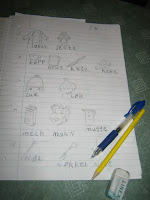
Nyuay Ong immediately charmed everyone here! She is a fantastic worker, never late, always doing everything that has to be done with high speed and a warm smile :-) And when there is little to do at the café, she sits down with Annie, a pensioner, at a table to learn Norwegian. Annie is fantastic! She has made a private "book" with drawings for Nyuay Ong, teaching her words that might be useful for her. It is much easier to understand when you can see the words either in real life or in pictures and drawings. (And you, my friend, can click on this photo to learn a few Norwegian words too - as a preparation for the visit in June 2010!)

Nyuay Ong's week is now filled with 2 days work and 3 days at Fredheim school. I visit her at work nearly every week, checking up on her development in the language and her understanding of the routines at a café. She seems to be very content with this, and she and her colegues have a nice time working together.

viernes, 13 de noviembre de 2009

La prensa regional con "sin barreras" - Regional media with "without barriers"

Os mostramos el artículo publicado por el diario regional "la Voz de Galicia" sobre nuestra última visita a Alemania


We show to you the article published by the regional newspaper "la Voz de Galicia" about our last visit to Germany